
Spanish Prime Minister Pedro Sanchez told parliament on 25 March 2026 that Israel "seeks to inflict the same level of damage and destruction" on Lebanon as it has on Gaza, while condemning a broader US-Israeli military campaign against Iran as "far worse" than the 2003 invasion of Iraq.[1]
Dispatch
MADRID, 25 MARCH 2026 — Al Jazeera reported Sanchez's parliamentary address, in which the left-wing prime minister articulated Spain's most explicit challenge yet to both Israeli military strategy and American regional policy.
Spanish Prime Minister Pedro Sanchez has said Israel "seeks to inflict the same level of damage and destruction" on Lebanon as on the Gaza Strip, as its army continues attacks across the neighbouring country amid plans to occupy its south. In an address before the lower house on Wednesday, Sanchez also said his government stood against the United States-Israeli war on Iran, which presented a "far worse" scenario than the invasion of Iraq in 2003.[1]
Sanchez escalated his rhetoric further when characterizing Iran's new leadership:
"This is not the same scenario as the illegal war in Iraq. We are facing something far worse. Much worse. With a potential impact that is far broader and far deeper," he told parliament. Sanchez added that Iran's new supreme leader was more hardline than his predecessor. "Mojtaba Khamenei is an equally dictatorial and even more bloodthirsty tyrant than his father," he said.[1]
A contrasting reading comes from Israeli Defence Minister Israel Katz, who explicitly confirmed the operational template Sanchez was warning against:
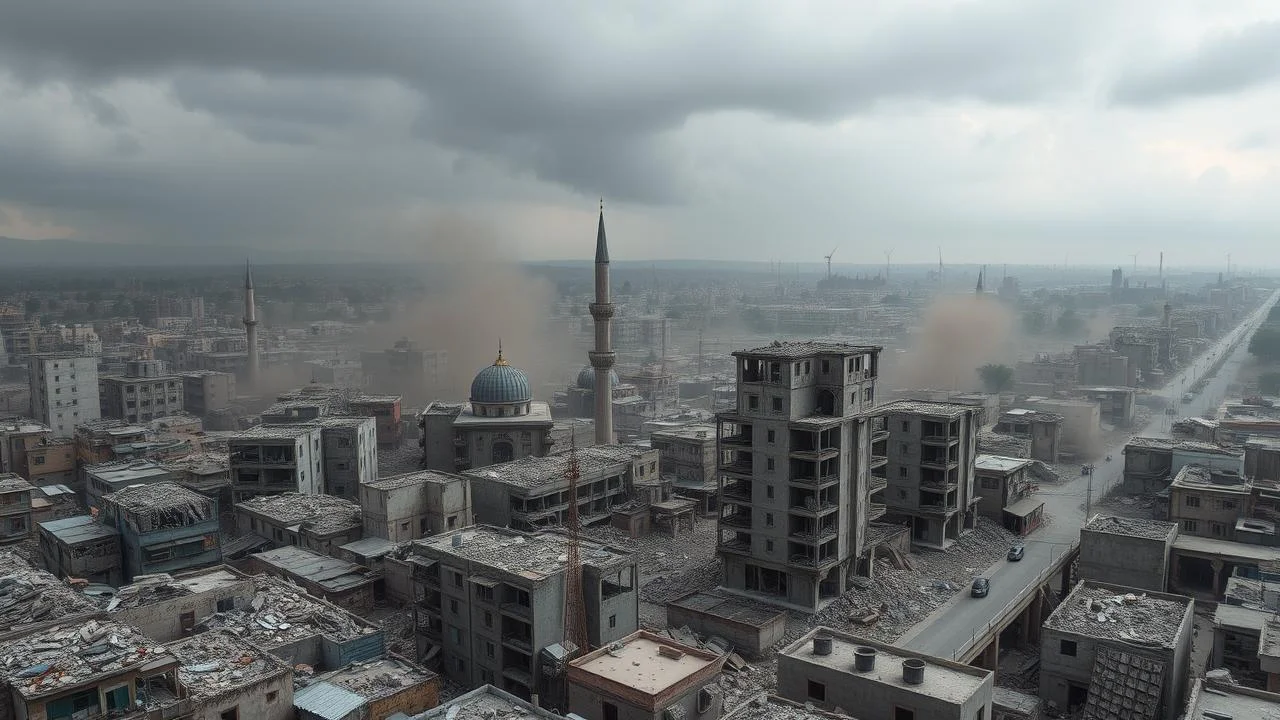
Israel's Minister of Defense Israel Katz said Israel's military was "following the model of Rafah and Beit Hanoon" in Lebanon, two cities in Gaza that were razed to the ground amid the genocidal war on the Palestinian enclave.[1]
This is not diplomatic obfuscation. Katz named the precedent directly. Rafah and Beit Hanoon were subjected to sustained bombardment, ground operations, and displacement campaigns that left both cities substantially destroyed.[1] The fact that an Israeli defence minister would invoke these as operational models for Lebanon suggests the parallel Sanchez drew is not rhetorical flourish—it reflects stated Israeli doctrine.
What's Really Happening
The Real Stakes
For Lebanon: A Israeli occupation of southern Lebanon, modeled on Gaza operations, would displace hundreds of thousands of Lebanese civilians, destroy critical infrastructure, and destabilize a country already fractured by the Syrian civil war, Hezbollah's military presence, and economic collapse. Lebanon's state capacity is minimal; its economy is non-functional. An Israeli occupation would create a humanitarian vacuum that neither the Lebanese government nor international institutions are equipped to manage. The parallel to Gaza is precise: territorial control, population displacement, infrastructure destruction, and indefinite occupation with no political endgame.
For the EU: Sanchez's public break signals that Spain—a NATO member, EU member, and G20 economy—is willing to treat Israeli military operations as a disqualifying issue for diplomatic and economic relations. If other left-wing or centre-left EU governments follow (Portugal, Germany under a potential SPD-led coalition, parts of France), the EU could fracture on Middle East policy in ways unseen since the 2003 Iraq invasion. The US will read this as European defection from a key alliance priority. NATO cohesion on broader Middle East strategy could suffer.
For the US-Israel relationship: The framing of a US-Israeli Iran campaign as a separate, worse escalation is significant. Sanchez is not merely criticizing Israel; he is criticizing American strategy. This suggests that European governments are beginning to view the Iran operation (whatever its exact form) as the real flashpoint—more destabilizing than Gaza or Lebanon operations alone. If Iran retaliates militarily, the regional escalation could pull in Gulf allies, potentially disrupting energy markets and drawing NATO into a broader conflict.
For Iran's new leadership: Sanchez's characterization of Mojtaba Khamenei as "more bloodthirsty" than his father Ayatollah Ali Khamenei is significant because it suggests European intelligence assessments view the new supreme leader as more confrontational. This could mean Iran's response to the US-Israeli campaign will be more aggressive than a more pragmatic leadership might choose. Sanchez is signaling European concern that the Iran succession has shifted the calculus toward escalation.
Geopolitical Dimension
The story unfolds across three overlapping theatres:
Lebanon-Israel frontier: Israeli military plans for a 30km occupation of southern Lebanese territory represent the most immediate flashpoint.[1] This is not theoretical; Israeli forces are already conducting operations across the border. The occupation would formalize what is currently presented as a temporary military incursion. Lebanese sovereignty becomes the first casualty. Hezbollah's role as a state-within-a-state in southern Lebanon means that Israeli occupation would inevitably trigger sustained resistance operations, converting the occupation into a long-term counter-insurgency campaign—precisely the Gaza model.
Iran-US-Israel triangle: The US-Israeli military campaign against Iran (referenced but not detailed in the source) is the strategic driver.[1] Sanchez frames this as worse than Iraq 2003 because it risks direct great-power confrontation. If Iran retaliates against Israeli or American targets, the US would face pressure to respond, potentially triggering a cycle of escalation that could involve Gulf allies, NATO members (through NATO bases in the region), and potentially Russian or Chinese intervention in the form of diplomatic or military support to Iran.
European fracture: Spain's explicit condemnation and arms embargo represent a European left position that is not yet majority but is becoming vocal. France and Canada have issued warnings but stopped short of Spain's rhetoric.[1] Germany remains aligned with the US. The UK is not mentioned in the source material. This divergence matters because European disunity on Middle East policy weakens the EU's ability to negotiate a settlement or contain escalation. The US will face pressure to choose between its European allies and its Israeli-Gulf alliance, a choice that could reshape NATO cohesion.
Impact Radar
Watch For
1. EU Council response to Spain's position (April 2026 onwards). If the EU issues a joint statement on Lebanon or Iran within 30 days, it will reveal whether Sanchez's position is isolated or represents a broader European shift. A strong EU statement backing Spain would signal that the US-Israeli strategy has fractured European consensus. No statement would suggest Spain remains an outlier.
2. Israeli military operations in southern Lebanon escalating to formal occupation (April-June 2026). If Israel announces a territorial administration or governance structure for occupied Lebanese territory (rather than framing it as temporary military operations), this would confirm Sanchez's warning and likely trigger EU diplomatic crisis. Watch for Israeli government statements on territorial control, not just military operations.
3. Iran's military response to the US-Israeli campaign (timeline unknown, but likely within 2-3 months of any major Israeli or American strike). If Iran retaliates with direct strikes on Israeli or American targets, Sanchez's warning about escalation will be validated, and the US will face immediate pressure to choose between European allies calling for de-escalation and Israeli demands for further strikes. Watch for statements from European capitals calling for ceasefire negotiations vs. US-Israeli statements demanding further operations.
4. Spain's parliament or government taking further action against Israel (e.g., sanctions on Israeli officials, formal recognition of Palestinian statehood). This would indicate whether Sanchez's rhetoric translates into sustained policy or is a one-off parliamentary statement. If Spain recognizes Palestinian statehood, it would be the first major EU member to do so, creating diplomatic pressure on other governments.
Bottom Line
Sanchez has named what other European leaders are thinking but not saying: Israel is applying a Gaza destruction model to Lebanon, the US-Israeli campaign against Iran represents a separate and larger escalation, and Europe is not prepared for the consequences. His isolation within the EU is real, but his warning reflects intelligence assessments shared across European capitals. The next 90 days will determine whether this is a Spanish outlier position or the opening of a broader European fracture over Middle East policy. If the latter, the transatlantic alliance faces its most serious test since 2003.