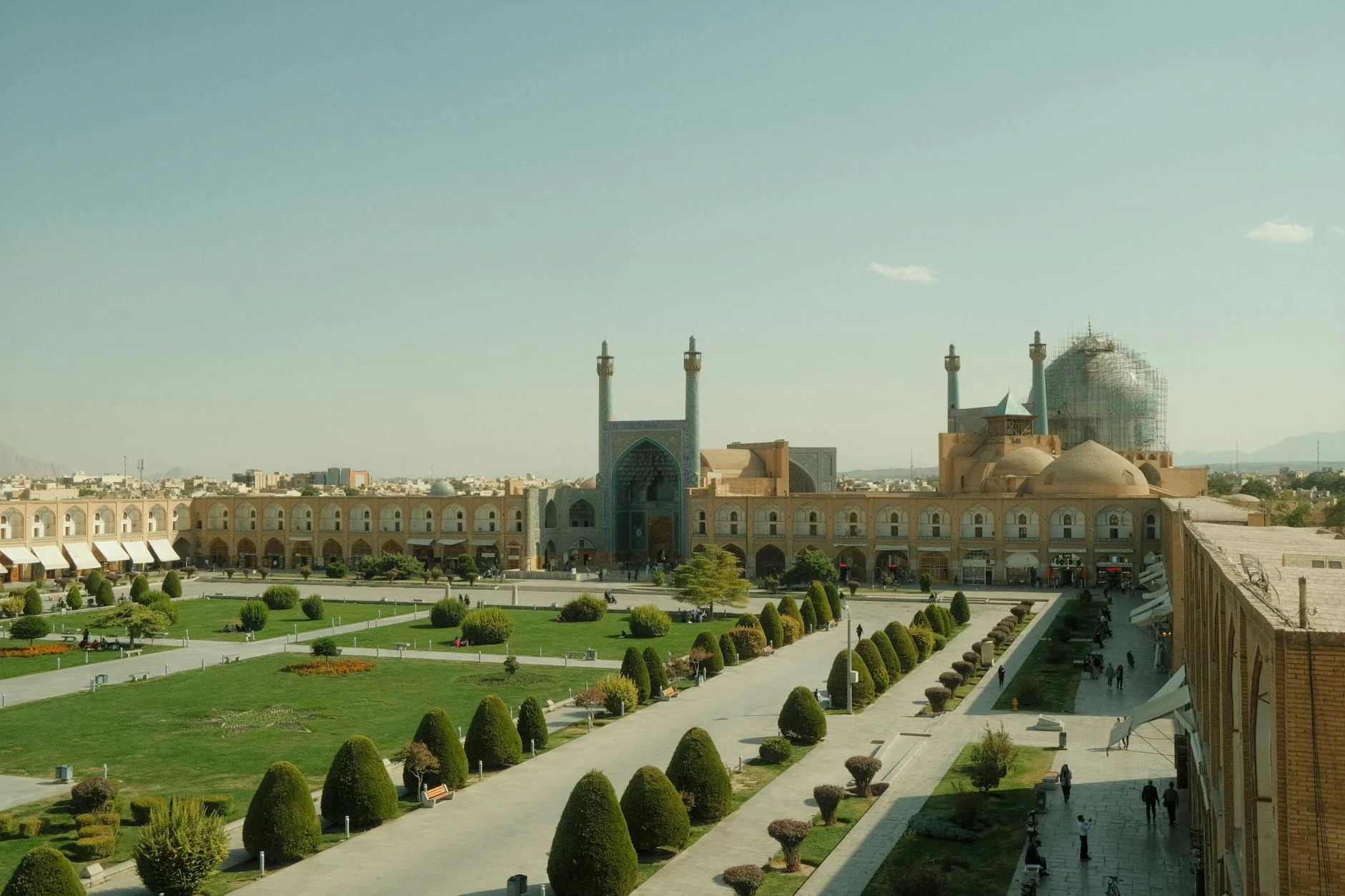
On 1 April 2026, video footage captured a massive column of smoke and burning embers towering over Isfahan, Iran, following coordinated strikes by US and Israeli forces. The attack targeted not only military installations but also two of Iran's largest steel producers—Mobarakeh Steel and Khuzestan Steel—marking a deliberate pivot from targeting command structures to dismantling the economic networks that sustain both Tehran's war machine and its civilian industrial base.
Dispatch
ISFAHAN, 1 APRIL 2026 — Al Jazeera reported the visual evidence first:
Video captured a massive column of smoke and burning embers towering over Isfahan, Iran following a US-Israeli strike.
Al Jazeera, 1 April 2026

The New York Times offered more granular detail on the scope and timing of the assault [1]:
Formidable strikes rocked Tehran early Wednesday morning. Iran launched what its state-aligned media called one of the largest attacks on Israel yet, damaging several cities. Hours before he was set to address the nation about the war in the Middle East, President Trump said that he no longer cared about Iran's stockpile of enriched uranium because it was buried deep underground. That is so far underground, I don't care about that, referring to near-bomb-grade uranium that international inspectors say could be used to produce nuclear weapons.
New York Times, 1 April 2026
A sharply different assessment came from the US Department of Defense, via Secretary of War Pete Hegseth, speaking to reporters at the Pentagon [2]:
The last 24 hours saw the lowest number of enemy missiles and drones fired by Iran, Hegseth told reporters. [Our strikes are damaging the morale of the Iranian military, leading to widespread desertions, key personnel shortages, and causing frustrations amongst senior leaders.] The United States conducted some 200 dynamic strikes through Monday evening, with fighter pilots being fed updated targeting information mid-air. [A dynamic target is one that changes while you're in the air because of improved intelligence, 200 dynamic strikes alone, in addition to the pre-planned targets,] Hegseth said, confirming that among the targets was an ammunition depot inside Iran's Esfahan nuclear complex.
US Secretary of War Pete Hegseth, Pentagon briefing, 1 April 2026
On the economic dimension, Deutsche Welle reported structural damage to Iran's industrial capacity [3]:
The bombing of two of Iran's largest steel producers, Mobarakeh Steel in Isfahan and Khuzestan Steel in Ahvaz, triggered a strong reaction inside Iran. Argus Media reported that the strikes damaged storage facilities and power infrastructure at both Khuzestan Steel and Mobarakeh, and said the attacks were expected to reduce Iran's production and its export capacity. The Wall Street Journal reported that Khuzestan Steel had halted operations, while Mobarakeh remained operational despite damage. Mobarakeh Steel alone generated $860 million (€741 million) in export revenue between March 2025 and January 2026, according to company linked-reporting.
Deutsche Welle, 1 April 2026
What's Really Happening
The Real Stakes
The Isfahan strikes mark a crossing of a threshold. Until now, the US-Israeli campaign could be framed as targeting Iran's military and command structure—the decapitation strategy that killed Ayatollah Ali Khamenei on 28 February. But the bombing of two of Iran's largest steel plants reframes the war as one of economic annihilation. Mobarakeh Steel alone represents $860 million in annual export revenue [3]. Its destruction does not degrade Iran's ability to launch missiles; it degrades Iran's ability to feed its population and pay its soldiers once the war ends.
This is the logic of strangulation. Hegseth's admission that Iranian missile strikes have fallen to their lowest level [2] suggests the Iranian military is already fragmenting. [Widespread desertions,] [key personnel shortages,] and [frustrations amongst senior leaders] are not the language of a force regrouping for a counteroffensive—they are the language of institutional collapse. If this assessment is accurate, Tehran faces a choice between negotiating from a position of catastrophic weakness or watching its state apparatus disintegrate.
But Trump's statement that he no longer cares about Iran's nuclear program [1] removes any natural endpoint from the conflict. When the nuclear constraint disappears, so does the off-ramp. The war becomes one of pure power projection: Can the US military break Iran's will to resist faster than Iran can exhaust American political will to continue?
The economic dimension is crucial here. An Iran-based economist told Deutsche Welle that [the longer the war continues, the more capital and state resources will be diverted toward conflict and away from managing Iran's already crisis-hit economy] [3]. If the fighting ends without political change and sanctions remain in place, skilled workers will flee the country, making economic recovery even harder. This is not speculation; it is the predictable outcome of sustained economic warfare against a state already under severe sanctions pressure.
The migrant worker exodus is a canary in the coal mine. The BBC documented that Filipino domestic workers—who earn $500 monthly in the Gulf, four to five times more than at home—are now reconsidering whether the risk of death is worth the salary [4]. If migrant workers are leaving the Gulf, the entire service economy of Saudi Arabia, the UAE, and Qatar faces a labor shock. One Filipino caregiver, Mary Ann Veolasquez, was already injured when a ballistic missile struck her apartment in Tel Aviv [4]. At least 12 South Asian workers have been killed [4]. When the conflict begins to kill the workers who sustain the economies of US-allied Gulf states, those allies will face domestic pressure to push for an end to the war.
Geopolitical Dimension
The strike on Isfahan reveals a fracture in the US-led coalition. Trump has explicitly criticized Britain and France for refusing to participate in the strikes. In a Truth Social post, Trump told Britain and France to [go to the Strait, and just TAKE IT] if they wanted oil, and warned that [the U.S.A. won't be there to help you anymore, just like you weren't there for us] [5]. This is not diplomatic language; it is a threat to withdraw the security umbrella from two permanent members of the UN Security Council.
NATO allies are already pushing back. The BBC reported that [one ally after another has held back from joining a war they weren't consulted on, given they still don't understand its goals in the face of mixed messaging from the Trump administration] [6]. Trump's threat to leave NATO over allied reluctance to join the Iran campaign is now explicit. This suggests that Trump views the war not as a regional conflict requiring allied consensus, but as an American operation in which allies either participate or lose US protection.
Iran's President Masoud Pezeshkian has responded with a dual-track strategy. In a letter to the American people, he laid out historical grievances—the 1953 coup, support for the Shah, backing of Saddam Hussein—while [stressing that there was a distinction between the US government and the people of the United States] [7]. Simultaneously, Iranian state media reported that Pezeshkian said Iran has the [necessary will] to end the war, provided Tehran receives guarantees the conflict will not flare up again [8]. This is a negotiating signal, but it is also a signal of desperation: Tehran is offering to talk because its military is fragmenting.
The Strait of Hormuz closure is now the most consequential geopolitical lever. Traffic through the strait has fallen 90% [4]. David Miliband, president of the International Rescue Committee, warned that [over $100,000 worth of IRC humanitarian aid for lifesaving initiatives is trapped in its hub in Dubai] and that [30 percent of the world's fertilizer goes through there] [7]. This is not a minor disruption; it is a global food security crisis in slow motion. If the strait remains closed for another month, fertilizer shortages will cascade through Asia and Africa, and global oil prices will remain elevated, destabilizing economies already fragile from the pandemic and prior sanctions.
Impact Radar
Watch For
1. Iranian missile production capacity. If Iran's next round of strikes uses fewer missiles than the previous round (as Hegseth claims), watch for the threshold at which Iran's air defenses can no longer sustain offensive operations. Once Iran's inventory falls below a critical level—likely somewhere between 200–500 operational ballistic missiles—Tehran will be forced to choose between capitulation or ground warfare, neither of which favors Iran [2].
2. Steel plant operational status. Deutsche Welle reported that Khuzestan Steel had halted operations, while Mobarakeh remained operational despite damage [3]. Monitor commodity markets and Iranian trade data for signs of whether Mobarakeh can resume full production. If both plants remain offline for more than 60 days, Iran's export revenue will contract by an estimated $1.4–2.1 billion annually, accelerating economic collapse.
3. Migrant worker departure rates from Gulf states. Track labor statistics from the Philippines, India, Pakistan, and Nepal for the rate at which workers are returning home. If departures exceed 10% of the Gulf's migrant workforce in the next 30 days, Saudi Arabia and the UAE will face acute labor shortages in healthcare, construction, and domestic work—creating domestic political pressure to push for a ceasefire [4].
4. Trump's next public statement on Iran's nuclear program. His statement that he no longer cares about enriched uranium [1] contradicts his stated war objective. Watch for whether he clarifies a new objective or simply escalates without one. If he escalates without defining an endpoint, the war becomes one of indefinite attrition.
Bottom Line
The Isfahan strikes represent a strategic shift: the US-Israeli campaign is moving from decapitation to systematic economic strangulation. Iran's military is fragmenting (confirmed by Hegseth's admission of record-low missile strikes), but the war has no defined endpoint because Trump has abandoned the nuclear constraint as justification. The real constraint now is the migrant worker exodus from the Gulf and the resulting pressure on US allies to demand a ceasefire. Within 30–60 days, if Iran's steel plants remain offline and worker departures accelerate, the geopolitical pressure on Saudi Arabia and the UAE to broker a settlement will become irresistible—forcing either a negotiated Iranian capitulation or a prolonged war of attrition that destabilizes the entire global economy.
---