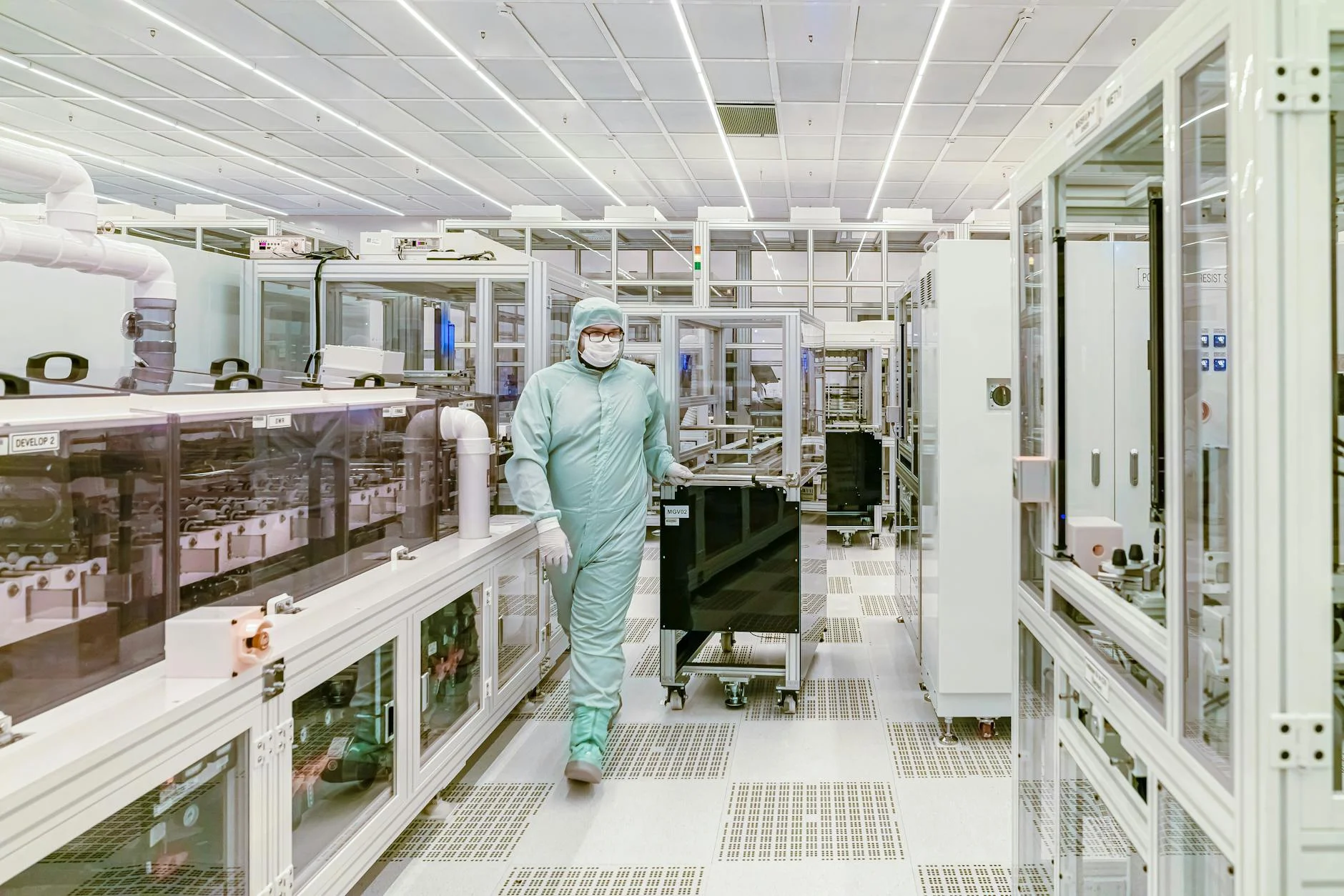
SHANGHAI, 27 March 2026 — Semiconductor Manufacturing International Corporation (SMIC), China's flagship contract chipmaker, released a 2026 action plan focused on strengthening its existing capabilities in older-generation semiconductor processes rather than pursuing the cutting-edge technology where the real competitive battle is being fought. The move signals both ambition and realism: SMIC knows where it can win, and it is betting China's self-sufficiency drive can survive on those terms.
Dispatch
SHANGHAI, 27 March 2026 — Ann Cao, reporting for the South China Morning Post, documents SMIC's strategic pivot:
Semiconductor Manufacturing International Corp (SMIC) launched an action plan to enhance its current businesses and seek new growth in 2026, as the largest contract chipmaker in China aims to solidify its role as the backbone of the country's self-sufficiency drive. Released alongside its annual report for 2025, the plan outlined a commitment to "optimising existing stock and digging for new increments", the company said in a stock exchange filing on Thursday. The company said two trends would continue to bring new growth opportunities to the domestic semiconductor industry this year: the return of the supply chain from overseas and the replacement of older products made overseas with new domestic ones.[1]
Under the trends, SMIC said it would deepen its expertise in specialised fields such as BCD (bipolar-CMOS-DMOS) technology, which combines the strengths of three different process technologies onto a single chip, as well as analogue chips, specialised memory chips and microcontroller units.[1]
South China Morning Post, 27 March 2026
The SCMP report also notes a critical external pressure: the global semiconductor market is experiencing a memory chip super cycle driven by artificial intelligence data centre demand, which is currently squeezing memory chip supply for consumer devices.[1] SMIC frames this squeeze as both a constraint on its own capacity and an opportunity — if it can capture the displaced mid-range and low-end production that would otherwise flow to overseas competitors.
No major outlet has yet offered a contrasting account of SMIC's announcement. This analysis draws from the single source above, supplemented by structural context about China's semiconductor position.
What's Really Happening
The Real Stakes
Confirmed: SMIC is China's largest contract chipmaker and the primary vehicle for domestic chip production outside the state-owned enterprises.[1] The company's 2026 plan commits it to deepening expertise in mature-node segments: BCD, analogue, specialised memory, and microcontrollers.[1] These are real markets — global analogue chip revenue exceeds $60 billion annually — but they are not where semiconductor competition is being decided in 2026.
Projected: Industry analysts expect Chinese chipmakers to capture 15–20% of the domestic mature-node market by 2027, up from roughly 8–10% today, as substitution accelerates and US sanctions limit foreign competitors' access to Chinese customers.[2] This is plausible — but it assumes SMIC can maintain yield and delivery reliability while ramping production, a challenge the company has faced repeatedly in its history.
One scenario: If SMIC successfully captures 18% of China's analogue and BCD markets by end-2027, the company could add $400–600 million in annual revenue. That would represent 12–15% growth, justifying the above-average growth language in the company's filing.[1] But this growth would come from displacement of existing overseas suppliers, not from new demand creation. The pie would not grow; SMIC's slice would.
The real stakes are structural, not numerical. Beijing's semiconductor self-sufficiency drive has three layers: advanced logic (where SMIC cannot compete), memory (where SMIC has limited exposure), and mature nodes (where SMIC is now betting its strategy). If China can achieve 70–80% self-sufficiency in mature nodes, it reduces vulnerability to US sanctions on consumer electronics and automotive. That is meaningful geopolitically, even if it does not make China a semiconductor superpower. But it also means accepting a world where China depends on foreign suppliers for the most advanced chips — the ones that power AI servers, 5G infrastructure, and military systems. SMIC's plan does not change that dependency; it manages it.
Geopolitical Dimension
The US sanctions regime against China's semiconductor sector — which has intensified since 2022 — created the conditions for SMIC's pivot. By restricting SMIC's access to advanced chipmaking equipment from companies like ASML (Netherlands), Applied Materials (US), and Lam Research (US), Washington forced Chinese policymakers to choose between pursuing advanced nodes (a costly, uncertain path) and consolidating leadership in segments where Chinese firms already have scale.[3] SMIC's 2026 plan represents Beijing's acceptance of this constraint. The company is not trying to break the sanctions; it is trying to prosper within them.
This has implications for Taiwan and South Korea. Taiwan's TSMC and South Korea's Samsung will not lose sleep over SMIC's mature-node ambitions — those markets are mature and lower-margin. But they will watch closely to see whether SMIC's success in capturing domestic substitution accelerates. If Chinese customers can reliably source mature-node chips domestically, they have less need for overseas suppliers, which tightens the noose around Taiwan's and South Korea's commercial leverage in China. Over a five-to-ten-year horizon, this is a significant geopolitical shift, even if it does not change the balance of power in advanced semiconductors.
The EU and Japan, which have less exposure to China's mature-node market, are less directly affected. But they will observe whether SMIC's strategy validates a broader pattern: China accepting technological parity in mature segments while pursuing independence through substitution rather than innovation. If that pattern holds across other sectors (automotive, industrial equipment, precision machinery), it suggests a more durable bifurcation of the global economy than many Western policymakers expected.
Industry Context
SMIC's plan must be read against the history of China's industrial policy successes and failures. In solar photovoltaics, Chinese manufacturers achieved cost leadership through massive scale and state support — by 2020, China controlled roughly 80% of global solar module production.[4] In electric vehicles, BYD and others have captured 60% of the global EV market through a combination of battery technology, cost advantage, and domestic policy support.[5] But semiconductors are different. The sector has higher barriers to entry, longer development cycles, and deeper integration with geopolitics. SMIC's strategy — competing in mature nodes rather than chasing advanced processes — is a tacit acknowledgment that the solar and EV playbooks do not fully transfer.
The memory chip super cycle mentioned in the SCMP report adds urgency to SMIC's timing. Global DRAM and NAND flash prices have risen 30–50% in the past 18 months, driven by AI data centre buildout.[6] This creates both opportunity and pressure. Opportunity: if SMIC can secure orders for specialised memory chips, margins are temporarily attractive. Pressure: the same cycle is consuming wafer capacity, meaning SMIC cannot easily expand production without new fabs — and new fabs require capital and equipment that may be harder to source under sanctions.
Impact Radar
Watch For
1. SMIC's 2026 capital expenditure announcement. If the company commits to building new mature-node capacity (a new fab or significant expansion), it signals confidence in sustained demand. If capex remains flat or declines, it suggests SMIC is managing expectations. Watch for an announcement by Q3 2026; SMIC typically guides capex in its quarterly earnings calls.
2. Customer qualification announcements from Chinese OEMs. Track whether major Chinese smartphone makers (Xiaomi, OPPO, Vivo), automotive suppliers (BYD, Geely), or consumer electronics manufacturers (Haier, TCL) announce they are qualifying SMIC chips for production. Each qualification represents a step toward substitution. If SMIC announces five or more major customer qualifications by end-2026, the substitution thesis is gaining traction.
3. US export control updates targeting mature-node equipment. The Biden and Trump administrations have focused sanctions on advanced-node tools. If the US expands restrictions to mature-node equipment (a lower probability but non-zero risk), SMIC's plan becomes significantly harder to execute. Monitor US Commerce Department regulatory filings and statements from semiconductor equipment makers for signals of this shift.
4. TSMC and Samsung pricing moves in China. If TSMC or Samsung aggressively cut prices for mature-node services in China to defend market share against SMIC, it signals they view SMIC's substitution threat as credible. Price cuts would validate SMIC's opportunity but also compress margins for all players.
Bottom Line
SMIC's 2026 action plan is a rational response to sanctions and market structure, not a breakthrough toward semiconductor independence. The company will likely capture incremental share in mature-node segments — BCD, analogue, specialised memory — where Chinese customers face real incentives to substitute away from overseas suppliers. But this does not close China's technology gap in advanced semiconductors, nor does it alter the strategic balance in chips that matter most: those powering AI, 5G, and military systems. For Beijing, it is an acceptable outcome — a way to reduce vulnerability in lower-tier semiconductors while accepting continued dependence on foreign suppliers for the frontier. For investors, it signals that SMIC's growth will be steady but not exceptional, and that competition in mature nodes will intensify as Chinese rivals (including state-owned enterprises like CITIC Semiconductor and JCET) pursue similar strategies.